
SIP for ₹1 Crore Goal: How to Build a ₹1 Crore Corpus Through Systematic Investing
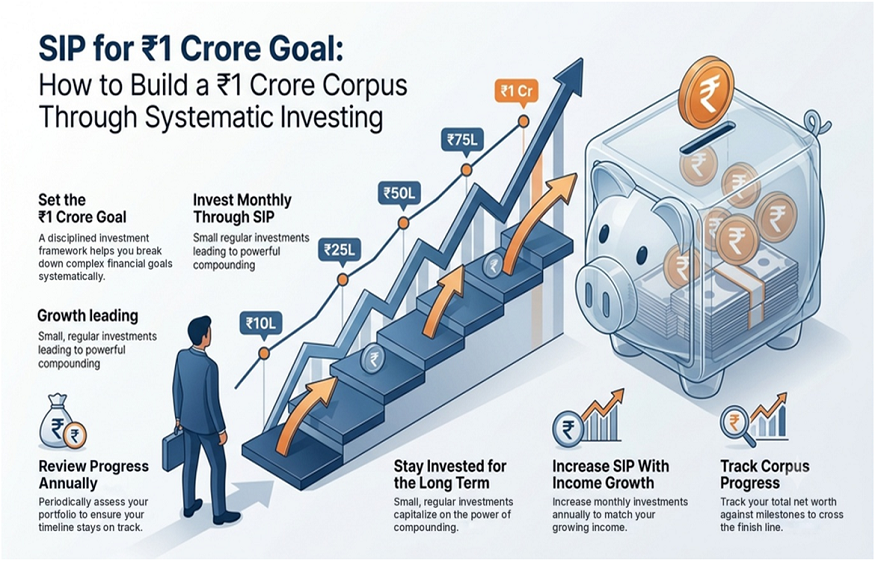
For many Indian investors, reaching a ₹1 crore corpus represents an important financial milestone. It can be associated with long-term goals such as financial independence, retirement, children’s education, buying a home or simply creating a stronger financial cushion. However, ₹1 crore is not necessarily a fixed measure of financial security. Its adequacy depends on your age, lifestyle, liabilities, inflation and future financial requirements.
A systematic investment plan (SIP) can provide a disciplined way to work towards such a long-term target. Instead of trying to accumulate ₹1 crore through occasional investments, an investor can break the goal into manageable monthly contributions and review the plan periodically.
Start With the Time Horizon
The monthly investment required for a ₹1 crore goal depends largely on how much time you have. A sip calculator can help estimate the monthly SIP required based on the target corpus, investment horizon and assumed annualised return.
For example, consider an assumed annualised return of 10%, purely for illustration:
- 10 years: approximately ₹48,500 per month
- 15 years: approximately ₹24,100 per month
- 20 years: approximately ₹13,200 per month
- 25 years: approximately ₹7,600 per month
These figures demonstrate why starting early can make a significant difference. A longer investment period allows more time for contributions and potential compounding to work together.
However, the assumed 10% return is not guaranteed. Mutual fund investments are market-linked, and actual returns can vary significantly.
The Power of Consistency
The concept behind an SIP for 1 crore is relatively straightforward: invest a fixed amount regularly toward a defined long-term objective.
For someone beginning with a ₹10,000 monthly SIP, increasing the contribution periodically can make the plan more dynamic. If income rises over time, an annual SIP step-up can increase the investment amount rather than keeping it unchanged for decades.
For instance, an investor might begin with ₹10,000 per month and increase the contribution by 10% every year. The actual corpus would depend on the investment return and the timing of each contribution, but the approach allows investment capacity to grow alongside income.
Don’t Focus Only on the ₹1 Crore Number
A ₹1 crore target sounds substantial today, but inflation reduces the purchasing power of money over time.
If inflation averages 6% annually, ₹1 crore received 20 years from now would have significantly lower purchasing power than ₹1 crore today.
Therefore, your SIP 1 crore plan should answer two questions:
Read More: Understanding Nominee and Joint Holder Benefits in Savings Accounts
When do I want to reach ₹1 crore?
What will ₹1 crore be worth when I reach that goal?
If the objective is retirement, for example, you may need a considerably larger corpus depending on your expected retirement expenses and years of retirement.
Align Investments With the Goal
The investment choice should depend on your time horizon and risk tolerance rather than simply targeting the highest possible return.
For a long-term goal, investors may consider diversified market-linked investments appropriate to their risk profile. As the target date approaches, protecting the accumulated corpus becomes increasingly important.
It can therefore be useful to review the portfolio periodically and gradually reduce exposure to significant market volatility when the money will soon be required.
The SIP amount and asset allocation should not be treated as “set and forget” decisions.
Track Progress Beyond the SIP
Reaching ₹1 crore is not determined solely by your monthly SIP. Existing investments, bonuses, annual step-ups and additional contributions can all influence the final corpus.
Regularly tracking your current portfolio value against the target can help identify whether you are progressing according to plan.
If there is a shortfall, you have several variables to review: investment amount, time horizon, goal value and expected return assumption. Increasing the SIP or extending the timeline may sometimes be more practical than taking excessive investment risk.
₹1 Crore Is a Milestone, Not the Destination
The appeal of a ₹1 crore target lies in its simplicity. It gives investors a clear number to work toward and can make long-term investing feel more tangible.
But the right target is personal. Someone planning retirement may require substantially more than ₹1 crore, while another person may use ₹1 crore as one milestone within a broader financial plan.
A disciplined SIP for 1 crore should therefore begin with a realistic assessment of your goals, timeline and future purchasing power.
The basic framework is simple:
Define the goal → choose the timeline → calculate the SIP → invest consistently → increase contributions with income → review the plan periodically.
With discipline and a sufficiently long horizon, an SIP can turn an aspirational ₹1 crore target into a structured financial goal. The focus, however, should remain on building a corpus that is meaningful for your future needs rather than pursuing a headline number simply for its own sake.
Read More: The Accounting Talent Shortage Is Hitting Washington Firms Hard
Disclaimer: This article is for educational purposes only
and should not be considered investment advice. Mutual fund investments are
subject to market risks, and returns are not guaranteed. All return and
inflation assumptions used above are illustrative. Actual investment outcomes
and future costs may differ.